
 Wildlife
of New Zealand
Bar-tailed Godwit
Waders & Shorebirds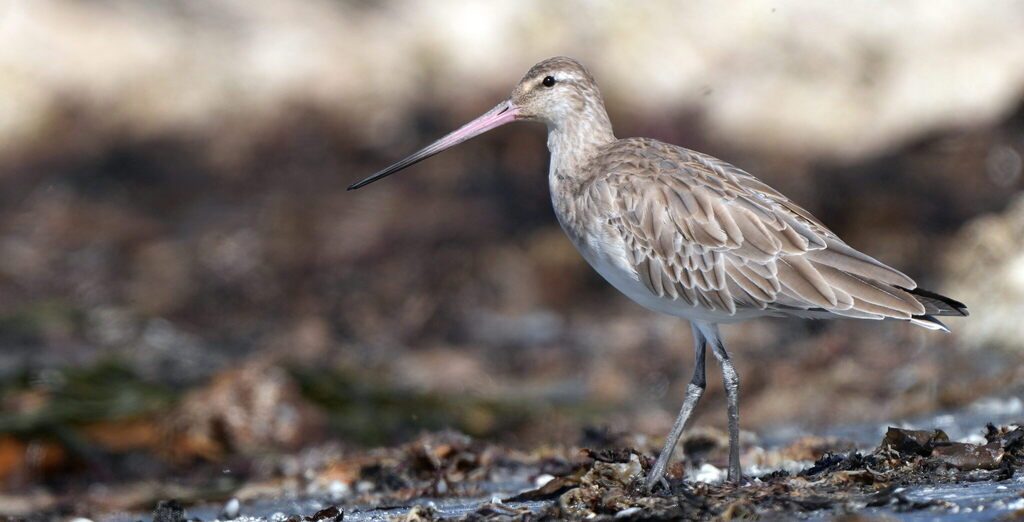
Photo: William Harland · CC BY 4.0 (May be cropped or resized)
Limosa lapponica
Basic stats
Habitat
Harbours, estuaries and tidal flats
Range
Most harbours; peak Sep–Mar
Size
Length 39–41 cm; weight 275–600 g
The bar-tailed godwit, or kuaka, is a large wader that flies nonstop from Alaska to New Zealand each spring, one of the longest uninterrupted migrations of any bird. A long-legged brown-and-pale wader with a long, slightly upturned bill, pink at the base and black at the tip. Breeding males turn bright rufous on the head and underparts; in non-breeding plumage the sexes look alike. Females are larger with longer bills. Black-tailed and Hudsonian godwits show white wingbars and rumps.
About 75,000 birds arrive each year, mostly the baueri subspecies that breeds in western Alaska. They gather on most harbours and estuaries, with the largest flocks at Parengarenga, Kaipara, Manukau, the Firth of Thames and Farewell Spit. Godwits probe mudflats for polychaete worms, which make up most of the diet, along with small bivalves and crustaceans; on wet pasture they take land invertebrates. They arrive from early September and begin leaving in March. Birds do not breed until their third or fourth year, so some stay through the winter.
The New Zealand classification is At Risk – Declining; the population is falling by nearly 2% a year, mainly through habitat loss at Yellow Sea staging sites. Manukau Harbour, Kaipara Harbour, the Firth of Thames, Farewell Spit and Parengarenga are the main sites, with Invercargill Estuary, Avon-Heathcote and Tasman and Golden Bays also good in summer.
Quick answers
- What habitat does the Bar-tailed Godwit live in?
- Harbours, estuaries and tidal flats
- Where is the Bar-tailed Godwit found?
- Most harbours; peak Sep–Mar
- How big is the Bar-tailed Godwit?
- Length 39–41 cm; weight 275–600 g